
Best Turntable Under £1000 UK 2026 | Rega, Pro-Ject and Technics Compared

Vinyl collector for over thirty years. Found my first turntable and a box of records in the loft at twelve — Nashville Skyline, After the Gold Rush, Disraeli Gears. Still spinning on a vintage Sony PS-X600.
Just so you know, some links on this page are affiliate links. If you buy something via them, we get a small kickback. You don't pay more, but it helps toward the next record.
Spend between £500 and £1,000 on a turntable and something changes. Not just incremental improvement, a genuine shift in what the music sounds like. The groove noise that was always there disappears. Instruments separate properly in the stereo image. Bass becomes defined rather than thudded. You stop hearing the turntable and start hearing the record.
My recommendation for most people in this range: the Rega Planar 3. It is not the most feature-rich deck here, and it has no built-in phono preamp, but based on everything I've read across What Hi-Fi?, Stereophile, and thousands of owner reports on r/vinyl and r/audiophile, it consistently delivers the most musically engaging sound at this price. If you want a preamp included, all the details are below.
Prices checked April 2026.
My Picks at a Glance
Not sure which setup is right for you?
Take Our QuizTake our quiz if you want a personalised recommendation based on your setup and listening habits.
Why These Picks
I've spent considerable time reading through expert reviews, owner discussions, and long-term reports. My criteria: each deck has to represent a genuine step up from the turntables in the £200–£500 range, not just a cosmetically different version of the same components. I excluded decks that earn recurring complaints about motor noise, speed stability, or manufacturing inconsistencies within the first two years of ownership. Everything here has a strong track record across multiple review cycles.
Rega Planar 3: The One I'd Recommend to Most People
The Rega Planar 3 has been the benchmark at this price for decades, through four major generations of revision, the philosophy has not changed. Make the plinth as rigid as possible. Keep the tonearm bearing tolerances exceptionally tight. Remove everything that does not directly contribute to extracting music from a groove.
The current Planar 3 uses a hand-assembled RB330 tonearm. Rega hand-builds and sets up the bearing in the UK, which is why their tonearms outperform competitors at the same price, there is actual craft involved, not just better materials. The phenolic platter, the double-brace plinth reinforcement, the precision motor: every choice makes the same argument. Less vibration reaching the stylus means more of the record actually heard.
What Hi-Fi? gave it five stars and called it "one of the best turntables you can buy at the money." That verdict has held across multiple review cycles. The consensus on r/vinyl from owners who have had theirs for five or ten years is consistent: it gets out of the way and lets you hear the record.
The honest limitations are real ones. There is no built-in phono preamp, you need an amplifier with a phono input or a standalone stage (the Rega Fono Mini at around £95 is the natural pairing). Speed changes between 33 and 45rpm require manually lifting the belt. Setup is not complicated, but it is not plug-and-play either. If those are dealbreakers, the Technics SL-1500C below solves both.
Pairs best with a mid-range amplifier that has a quality phono stage, the Denon PMA-600NE or the Yamaha A-S301 in the best amplifier for turntable guide are the natural partners at this deck's level. Check Price on Amazon
Five-star turntable with hand-assembled RB330 tonearm. The benchmark at this price, consistently.
Pro-Ject Debut Carbon EVO: The Feature-Complete Alternative
The Pro-Ject Debut Carbon EVO takes a different approach: more features, more convenience, and a starting cartridge (the Ortofon 2M Red) that most competitors charge extra for or do not include.
The 8.6" one-piece carbon fibre tonearm is the headline specification. Carbon fibre is stiff and lightweight, the ideal material for a tonearm that needs to be resonance-free without adding mass that would reduce tracking ability. Pro-Ject makes their own tonearms in Austria, and the carbon version is a genuine upgrade over earlier aluminium iterations.
Electronic speed selection between 33 and 45rpm is a practical win over belt-swapping decks. Press a button and the motor changes speed precisely. For anyone who plays a lot of 7-inch singles alongside albums, this is not a trivial convenience, manually lifting a belt while a record waits on the platter is the kind of small friction that accumulates over time.
The Ortofon 2M Red comes pre-mounted and aligned. At around £100 bought separately, this is a meaningful inclusion that brings the real value of the deck closer to its asking price.
On pure sonic performance, most careful reviewers position the Planar 3 narrowly ahead. But the EVO's better features, included cartridge, and lower price close the value gap considerably. If you play a lot of 45s or prefer a simpler workflow, the EVO is the practical choice. Check Price on Amazon

Carbon fibre tonearm, electronic speed selection, Ortofon 2M Red pre-mounted. Made in Austria.
Rega Planar 2: The Step-In Rega
The Rega Planar 2 shares the Planar 3 philosophy in a simpler package. The RB220 tonearm (versus the Planar 3's RB330) and a steel platter versus phenolic are the main differences. The result is a turntable that sounds like a Rega, fast, rhythmically engaging, low-noise motor, at a lower entry price.
For someone coming from a budget deck who wants to understand why Rega has the reputation it does without spending £650 on the Planar 3, the Planar 2 makes a clean argument. The upgrade path is clear: add a better phono stage, then upgrade the cartridge, then consider stepping to the Planar 3 when it makes sense.
If you can stretch to the Planar 3, stretch. The RB330 tonearm is a meaningful improvement, and the phenolic platter adds measurable rigidity. But the Planar 2 is not a compromise, it sounds better than most of what competes near its price and gives you every upgrade option available to the Planar 3. Check Price on Amazon

Rega's entry to the premium tier. Same DNA as the Planar 3, simpler specification.
Technics SL-1500C: The Serious All-In-One
The Technics SL-1500C at around £900 justifies its price through a combination that nothing else here matches: professional-grade direct drive, a built-in phono stage designed to the standard of a standalone unit, and an Ortofon 2M Red cartridge included from the factory.
The motor technology descends directly from Technics' SL-1200 series, the decks that DJs have used professionally for fifty years. Coreless direct drive eliminates the cogging effect that plagued earlier direct-drive designs. Speed stability is exceptional and measurably better than belt-drive alternatives, including the Rega Planar 3. For classical music and jazz where tempo drift is audible on sustained notes, this matters.
The built-in phono stage is designed specifically to match the deck rather than added as an afterthought. Technics engineered it to pair with the 2M Red's output characteristics. Most owners report it outperforms external budget phono stages in direct comparison, the internal matching gives an advantage that separate components at the same combined cost struggle to replicate.
What belt-drive at the same price does differently: Rega's rigidity-obsessed plinth design creates a specific sonic character, fast, present, rhythmically alive, that some listeners strongly prefer over the Technics' precision. Both are real descriptions of real differences. Spend time with both if you can before deciding.
What to Avoid
Crosley Executive and similar "vintage-styled" premium-priced decks: A turntable that looks premium and costs premium should perform premium. Many retro-styled decks in this price range use the same ceramic cartridges and lightweight platters as £80 budget decks. The Crosley Cruiser in particular will damage records, the ceramic cartridge applies excessive tracking force that wears grooves within a few plays.
Denon DP-300F and similar semi-automatic decks in this range: Fully automatic operation is convenient, but the mechanism required adds mass, resonance, and mechanical complexity to the tonearm area. At this price you are paying for the mechanism rather than sound quality. The DP-300F earns consistent criticism for a built-in phono preamp that limits what the deck is capable of.
Cheap "audiophile" decks from unfamiliar brands: Several manufacturers produce decks with impressive-looking specifications at £400–£700 that attract attention on audio forums. Recurring patterns: speed instability, cartridge misalignment from the factory, support that disappears after the sale. Stick to brands with UK distribution and an established track record of standing behind their products.
Any turntable specifying a ceramic cartridge: If the spec sheet says "ceramic cartridge" or "ceramic stylus," do not buy it at any price. Ceramic cartridges apply excessive tracking force and damage records. Every deck in this guide uses a proper MM (moving magnet) cartridge.
Buyer's Guide: What Changes Above £500
Motor quality: Budget motors produce wow and flutter (speed variations) audible on sustained piano notes and orchestral strings. Above £500, that variation tightens dramatically. Pitch stability stops being something you compensate for and starts being something you take for granted.
Tonearm precision: The tonearm bearing determines how precisely the stylus tracks the groove. Sloppy bearings allow lateral wander that causes distortion and accelerates stylus wear. Above £500, bearing tolerances tighten measurably. Rega's RB330 is hand-assembled to specifications that sub-£300 tonearms cannot approach from the factory.
Platter mass and material: Heavier, more rigid platters store rotational energy more smoothly and resist external vibration. The Rega's phenolic platter and the Technics' die-cast aluminium platter both represent genuine improvements over the plastic platters on budget decks.
Upgrade headroom: Every deck here accepts cartridge upgrades. The RCA outputs work with better phono stages. Below £200, the turntable becomes the bottleneck before anything else improves. In this range, the bottleneck shifts to the amplifier and speakers, which is the correct order.
Pairing: What Else You Need
Phono preamp (for Rega decks): The Planar 2 and Planar 3 have no built-in preamp. You need either an amplifier with a phono input or a standalone stage. The Rega Fono Mini is designed specifically for Rega's cartridges. If your amplifier already has a phono input, use that first and add a dedicated preamp later when you want to upgrade.
Matching amplifier: A turntable in this range will reveal the limitations of a budget amplifier. The Cambridge Audio AXA35 pairs well with the Pro-Ject EVO and Rega Planar 2. The Rega Planar 3 and Technics SL-1500C both benefit from stepping up, and the Denon PMA-600NE or Yamaha A-S301 are the natural partners. See the best amplifier for turntable guide for the full breakdown.
Decent speakers: Better turntables reveal the limitations of speakers more clearly. Powered bookshelf speakers in the £150–£250 range or passive speakers with a separate amplifier are natural matches. Going significantly cheaper on speakers than the turntable wastes what the deck is capable of, the best speakers for turntable guide has the full matching guide.
FAQ
Is a £650 turntable really worth it over a £300 one? Yes, if your speakers and amplifier can reveal the difference. A Rega Planar 3 through a Cambridge Audio AXA35 and Q Acoustics 3020i speakers is an audibly different experience than an AT-LP60X through the same system. The limiting factor shifts from the turntable to the rest of the chain. If you have budget entry-level speakers, upgrade those first, they will make a bigger difference at this point.
Do I need a phono preamp for the Rega Planar 3? Yes. The Planar 3 has no built-in preamp, the signal from its cartridge needs amplification and RIAA equalisation before reaching a line-level input. If your amplifier has a dedicated PHONO input, use that. If not, add the Rega Fono Mini between the turntable and amplifier. Without a preamp, the turntable will produce almost no audible sound, this is the most common setup mistake at this price point.
Is direct drive or belt drive better at this price? Both are genuinely excellent in this range. Direct drive (Technics SL-1500C) excels at measurable speed accuracy and consistency. Belt drive (Rega, Pro-Ject) excels at isolating motor vibration from the stylus. The sonic difference is real but not a clear winner, it depends on the music you listen to and what you prioritise. For classical and jazz, direct drive's speed stability advantage is meaningful. For most other music, listener preference and practical features should decide it.
What cartridge upgrade should I do next? If you start with the Ortofon 2M Red (included with the Pro-Ject EVO and Technics SL-1500C), the natural upgrade is the Ortofon 2M Blue. Same body, better stylus, a genuine improvement in detail retrieval. For Rega decks with the included carbon cartridge, the Rega Exact or Audio-Technica AT-VM95ML are well-matched upgrades. See the cartridge upgrade guide for the full breakdown.
Can I use my old stereo receiver with a turntable in this range? Yes, if it has a phono input, most receivers made before the late 1990s do. Check the back panel for an input labelled PHONO. If it exists, connect the turntable there. The receiver's phono stage may not be as quiet or neutral as a dedicated modern unit, but it will work and you can always add an outboard preamp later. If the receiver has no phono input, add the Rega Fono Mini or similar between the turntable and any line input.
How much record cleaning equipment do I need at this level? More than at budget level. At £500+, the turntable is resolving enough to hear the difference between a clean and a dirty record. A basic anti-static brush removes surface dust before every play. A manual wet cleaning kit handles the deeper cleaning that a brush cannot. For serious record care, a machine like the Spin-Clean record washer is the most cost-effective thorough cleaning method available. Do not run dirty records on a Rega Planar 3, the cartridge and stylus are resolving enough to show it, and grit in grooves accelerates stylus wear.
How These Decks Compare Side by Side
| Rega Planar 3 | Pro-Ject Debut Carbon EVO | Rega Planar 2 | Technics SL-1500C | |
|---|---|---|---|---|
| Value | Upper-mid | Lower | Lower | Highest |
| Drive type | Belt | Belt | Belt | Direct |
| Built-in preamp | No | No | No | Yes |
| Included cartridge | Carbon (basic) | Ortofon 2M Red | Carbon (basic) | Ortofon 2M Red |
| Speed switching | Manual (belt lift) | Electronic (button) | Manual (belt lift) | Electronic (button) |
| Auto-stop | No | No | No | Yes (auto-lift) |
| Tonearm | RB330 (hand-assembled) | 8.6" carbon fibre | RB220 | Technics S-shaped |
| Best for | Pure sound, long-term system | Features and 45rpm use | Rega on a budget | Complete no-faff system |
Setting Up a Turntable in This Range
None of these decks require professional installation, but each has a setup step that matters more than at budget level.
Rega Planar 2 and Planar 3: The cartridge and counterweight arrive separately in the box. You need to mount the cartridge to the headshell using the supplied screws, attach the colour-coded cartridge leads, fit the counterweight, and set the tracking force. Rega's instructions are clear. The whole process takes around twenty minutes the first time. The critical step is balancing the tonearm to zero and then setting the tracking force to the cartridge's specification, 1.75g for the supplied carbon cartridge. Getting this right matters for both sound quality and stylus and record longevity.
Pro-Ject Debut Carbon EVO: The Ortofon 2M Red arrives pre-mounted and aligned. Counterweight installation and tracking force setting are still required (1.8g for the 2M Red). The EVO's electronic speed switching means no belt to move when changing from 33 to 45rpm, plug in, set tracking force, balance, play.
Technics SL-1500C: The most plug-and-play of the four. The Ortofon 2M Red comes factory-fitted and aligned. You set the counterweight and tracking force, connect the output to an amplifier or powered speakers via the built-in phono stage or direct line output, and play. The auto-lift mechanism at the end of a side is a genuine quality-of-life feature that belt-drive competitors at this price do not include.
Isolation: A turntable at this level will reveal vibration from footfalls and nearby speakers far more clearly than a budget deck. Put it on a solid surface, not a hollow-core shelf. A dedicated turntable isolation platform (around £30–£60 for a quality foam or cork option) is worthwhile if your furniture resonates. Feedback through the floor makes bass boom and inner groove distortion worse, isolation solves both.
Put on a record you know well through a turntable in this range and the experience is different from what you have had before. Not bigger or louder, more present. Less like a recording, more like a room. That is what this money buys.
What You'll Need With It
At this level of turntable, the source material quality becomes audible. Clean records before every play. Pressing compound on new records and surface dust on older ones are what get between the stylus and the music.
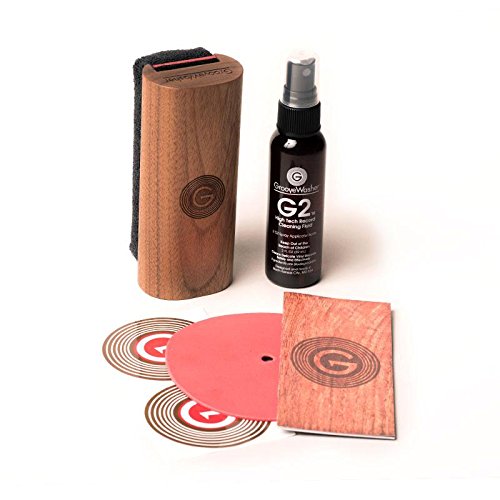
Professional cleaning system with microfibre brush, cleaning solution, and storage pouch. Safe for all vinyl types. Essential maintenance for preserving record quality.
The AT-VM95E is the standard first cartridge upgrade for any AT-LP120X in this tier. It tracks accurately, retrieves detail the stock cartridge smooths over, and leaves clear room to upgrade further.

Popular replacement cartridge with excellent tracking and detail retrieval. Easy to install, compatible with most turntables, and exceptional value. Direct upgrade for AT-LP120X owners.
Set your tracking force correctly after fitting any new cartridge. This gauge gives 0.01g precision. The difference between 1.7g and 2.0g is audible on a turntable at this level, and incorrect tracking force accelerates both stylus and record wear.

Accurate digital gauge ensuring optimal tracking force for cartridge longevity and sound quality. LCD display with 0.01g precision. Essential tool for turntable setup.
As an Amazon Associate, we earn from qualifying purchases.
Products Mentioned in This Guide
Find Your Perfect Setup
Answer a few quick questions and get personalised recommendations.
Start the QuizFrequently Asked Questions
What is the best turntable for under £1000?
The Rega Planar 3 (around £650) is the top recommendation for most people — hand-assembled RB330 tonearm, consistent five-star reviews, and a sonic character that owners describe as musical and engaging. The Technics SL-1500C (around £900) is the best choice if you want a built-in phono stage and direct-drive speed stability included.
Do I need a phono preamp for a Rega Planar 3?
Yes. The Rega Planar 3 has no built-in phono preamp. You need either an amplifier with a dedicated PHONO input (most hi-fi amplifiers include one) or a standalone phono preamp like the Rega Fono Mini (around £95). Without a phono stage, the turntable will produce almost no audible sound. The Technics SL-1500C and Pro-Ject Debut Carbon EVO both include built-in preamps.
Is belt drive or direct drive better at this price?
Both are genuinely excellent in this range. Belt drive (Rega, Pro-Ject) isolates motor vibration from the stylus and produces a sound many listeners describe as musical and fast. Direct drive (Technics SL-1500C) delivers measurably better speed stability, which benefits classical and jazz recordings particularly. Choose based on your music priorities and whether you want auto-features included.
How much should I spend on speakers to match a Rega Planar 3?
Budget at least £150–£250 on powered speakers, or the equivalent on passive speakers plus a separate amplifier. A Rega Planar 3 through budget speakers is a wasted investment — the limiting factor shifts from the turntable to the speakers. The Q Acoustics 3020i (around £200, passive) with a Cambridge Audio AXA35 amplifier (around £279) is a well-matched system.
Is the Pro-Ject Debut Carbon EVO better value than the Rega Planar 2?
The Pro-Ject EVO (around £450) includes the Ortofon 2M Red cartridge (worth around £100 separately) and electronic speed switching. The Rega Planar 2 (around £450) has a simpler cartridge but the characteristic Rega sound and a clear upgrade path. Both are excellent at the price. If you play a lot of 45rpm singles, the EVO wins on convenience. For pure sonic character matching the Rega upgrade path, the Planar 2.
Related Guides
Best Turntables Under £500 UK 2026: Rega vs Pro-Ject vs Audio-Technica vs Sony
Buying GuideBest Amplifier for Turntable UK 2026 | Budget to Audiophile
Buying GuideBest Speakers for Turntables UK 2026 | Active & Passive
Setup GuideTurntable Cartridge Upgrade Guide UK 2026 | From £50
ComparisonRega vs Pro-Ject Turntables UK 2026 | From £300
How-ToPhono Preamp Guide UK 2026 | Do You Need One? From £35
Buying GuideBest Turntable Under $1000 2026 | Rega, Pro-Ject and Technics Compared
Ready to find your perfect setup?
Our quiz matches you with the right turntable, speakers, and accessories.
Take the Quiz - It's FreeNo email required