
Audio-Technica AT-LP140XP vs LP120XBT 2026: Which Wins?

Vinyl collector for over thirty years. Found my first turntable and a box of records in the loft at twelve — Nashville Skyline, After the Gold Rush, Disraeli Gears. Still spinning on a vintage Sony PS-X600.
Just so you know, some links on this page are affiliate links. If you buy something via them, we get a small kickback. You don't pay more, but it helps toward the next record.
Here is a comparison almost nobody on the internet gets right, and the mistake costs people money. The Audio-Technica AT-LP120XBT-USB is the one I'd recommend for most people, because it plays music the day it arrives: built-in preamp, aptX Bluetooth, USB ripping, the upgradeable VM95E cartridge, plug it into anything and go. The AT-LP140XP is the better long-term sound, but only if you already own an amplifier with a PHONO input or a separate phono stage, because it deliberately strips out the preamp, the Bluetooth and the USB. Same heavy direct-drive chassis. Opposite philosophy. Here's the rule the UK comparison sites bury: if you have to ask whether you need a preamp, buy the LP120XBT.
Not sure which setup is right for you?
Take Our QuizBefore we go further, one correction, because it's the thing every other page gets wrong and it changes the whole decision. Allforturntables, versus.com, Vinyl Factory, devotedtovinyl and even the AT support pages all line the LP140XP up against the older USB-equipped LP120 models, and several state outright that the LP140XP has a built-in preamp or USB. It does not. The LP140XP has no preamp, no USB and no Bluetooth. That single error is why people buy it, plug it into powered speakers, and get almost nothing. Get that fact straight and the rest of this is easy.
Same Chassis, Opposite Philosophy
These two decks are built on the same bones. Both are the heavy Audio-Technica direct-drive platform: a high-torque motor that reaches full speed almost instantly, a balanced S-shaped tonearm with a hydraulically damped cue lever, an adjustable counterweight and real anti-skate. Audio-Technica didn't design two different turntables here. They took one good chassis and split it down the middle on purpose, building two products for two completely different buyers.
The LP120XBT is the convenience fork. AT loaded it with everything a new vinyl listener might want and asked for nothing in return: you open the box, plug it in, and music comes out. The LP140XP is the purist fork. AT pulled every convenience feature out, added mass and torque, and handed you a cleaner signal path on the condition that you bring your own amplification. One says yes to whatever setup you've got. The other assumes you're building, or already have, a proper system for it to sit in front of.
That's the frame the other comparisons miss entirely. They treat this as 'which is better,' when it's really 'which question is yours.' If you don't yet own an amp with a phono input or a standalone phono box, the LP120XBT isn't just the easier choice, it's the only one of the two that will make a sound. Get this distinction right and you genuinely can't pick wrong.
The Audio-Technica AT-LP120XBT-USB
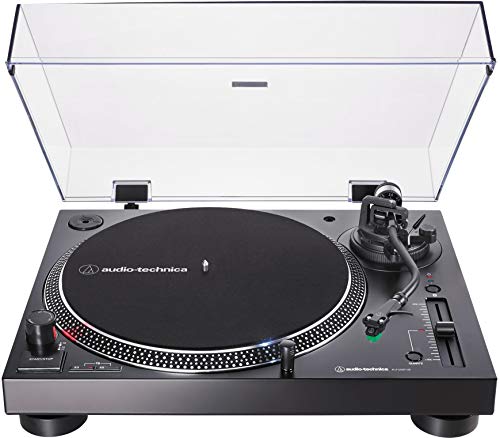
Professional Bluetooth turntable with direct-drive motor, USB output, and aptX Adaptive wireless. All the features of the LP120X plus wireless convenience. For enthusiasts who want flexibility.
The LP120XBT is the most versatile turntable Audio-Technica makes at this price, and it isn't close. It starts from that direct-drive chassis, the same architecture used in DJ and broadcast decks, so it locks onto speed instantly and holds pitch with rock-solid consistency. There's a pitch slider and selectable 33, 45 and 78 RPM, so it'll play shellac as well as modern records. The tonearm is the real thing, not a fixed plastic arm you can't adjust.
The cartridge is where it connects to the rest of the advice on this site. It ships with the Audio-Technica VM95E, the same upgradeable cartridge I rate as the best budget platform going. When you want more, you pull the stylus and clip on a finer one without buying a whole new cartridge. The Nagaoka MP-110 vs AT-VM95E guide explains why that upgrade path matters so much.
Then the connectivity, which is the entire point of this deck. The built-in switchable phono preamp means you plug it straight into any amplifier or powered speakers with a line input, no separate phono stage required. A USB output digitises your records to a computer. And Bluetooth with Qualcomm's aptX codec streams wirelessly to Bluetooth speakers or headphones. For someone in a flat, or without a traditional hi-fi, that wireless option is genuinely liberating. You can have a record spinning into a kitchen speaker within minutes of opening the box, with no extra spend.
The honest caveat, the one reviewers consistently raise, is the Bluetooth itself. aptX is convenient and it's better than standard SBC Bluetooth, but it runs your analog signal through a digital codec, and on a half-decent pair of speakers it sounds slightly closed-in compared to a wired connection. It's not bad. It's just not the deck at its best. Treat Bluetooth as the convenience option and run the wired output when you're actually sitting down to listen, and you lose nothing.
Who's it right for? Anyone who wants one box that handles everything. Anyone digitising a collection. Anyone without a separate amp who wants to stream to powered or Bluetooth speakers. Anyone who plays 78s, or thinks they might. And honestly, anyone who reads this far and feels a flicker of doubt about phono inputs and preamps, because this deck removes that whole question.
The Audio-Technica AT-LP140XP
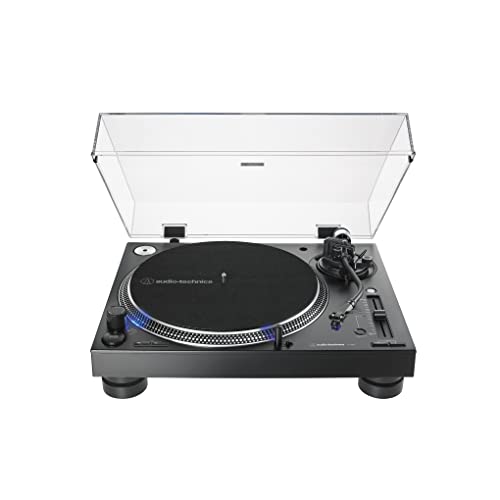
High-torque direct-drive turntable for the purist. No built-in preamp, USB or Bluetooth: a heavier, more damped plinth and a cleaner signal path designed to feed a proper amplifier with a phono input. Ships with the conical AT-XP3 cartridge.
The LP140XP is the same idea pointed in the opposite direction. AT took the platform, stripped out the preamp, the USB and the Bluetooth, and spent the freed-up budget and weight on the parts that affect sound. It's the deck for the buyer who wants the AT chassis but plans to feed it into a real system rather than power it from a phone app.
Start with what it adds. The motor torque steps up to 2.2 kgf.cm, noticeably higher than the standard platform, which means even more authoritative startup and speed stability. It carries a wider pitch range, plus or minus 8, 16 and 24 percent, a nod to its DJ heritage. And the plinth is around 2 kg heavier, with more internal damping, so the whole deck sits more planted and does a better job keeping motor and footfall vibration away from the stylus. Combined with the absence of a noisy onboard preamp circuit, the signal path is simply cleaner. On a capable system, that's audible.
Now the corrections, because this is where the internet has misled people for years. The LP140XP has no built-in phono preamp. None. You need an amplifier with a dedicated PHONO input, or a separate phono stage between the deck and your amp. It has no USB, so it cannot digitise records on its own. It has no Bluetooth. If you've read elsewhere that it does any of these things, that page is wrong, and following it will leave you with an expensive turntable and silence.
The cartridge correction matters just as much. The LP140XP does not ship with the VM95E. It comes with the AT-XP3, a conical-tipped DJ cartridge built for cueing and durability rather than fine detail. The XP3 is perfectly listenable, but it's the weak link in the box, and it's the reason this deck is such a clever long game. Because the XP3 shares the VM95-series stylus mount and sits in a standard half-inch cartridge body, upgrading to a VM95E is genuinely drop-in. You buy a body plus stylus, or just the VM95E, for around 20 to 25 pounds, swap it on, and you've transformed the sound for the price of a couple of records. The phono preamp guide covers the other half of that chain, the box you'll also need.
Who's it right for? Anyone whose priority is sound over convenience, who already has, or will buy, an amp with a phono input or a standalone phono stage. Anyone who likes the idea of buying the cheaper body now and growing into it with a better cartridge. And anyone who wants the heavier, higher-torque version of the AT chassis without paying for Bluetooth and USB they'll never switch on.
Head-to-Head
| Audio-Technica AT-LP140XP | Audio-Technica AT-LP120XBT-USB | Winner | |
|---|---|---|---|
| Drive | Direct drive, 2.2 kgf.cm torque | Direct drive | LP140XP (higher torque) |
| Built-in phono preamp | No | Yes (switchable) | LP120XBT |
| Bluetooth | No | Yes (aptX) | LP120XBT |
| USB digitising | No | Yes | LP120XBT |
| Included cartridge | AT-XP3 (conical, DJ) | VM95E (elliptical, upgradeable) | LP120XBT |
| Plinth and damping | Heavier, more damped (around +2 kg) | Standard | LP140XP |
| Pitch range | Plus/minus 8/16/24 percent | Standard pitch slider | LP140XP |
| Speeds | 33 / 45 (78 with adapter) | 33 / 45 / 78 | LP120XBT |
| Signal-path cleanliness | Cleaner (no onboard preamp) | Good, but busier | LP140XP |
| Works out of the box with powered speakers | No (needs phono stage) | Yes | LP120XBT |
| Cheapest route to best sound | Body plus VM95E upgrade | Locked-in convenience | LP140XP |
| Value as supplied | Needs extra purchases | Complete | LP120XBT |
Which One Should You Buy?
This is a routing decision, not a verdict on which deck is objectively better. Find yourself in one of these descriptions and the choice is made.
Buy the AT-LP120XBT-USB if you're the type of person who wants to plug in and listen tonight with nothing else to buy. You don't have a separate amplifier or phono stage, and the words 'phono input' make you slightly nervous. You want to stream a record to a Bluetooth speaker in another room, or rip your vinyl to a computer, or play 78s. You'd rather have a genuinely good upgradeable cartridge already fitted than shop for one. For the clear majority of people, especially first-time buyers, this is the sensible deck, and the VM95E in the box means it doesn't sound like a compromise.
Buy the AT-LP140XP if you're the type of person who already owns an amp with a PHONO input, or is happy to add a phono stage, and wants the cleanest sound the AT chassis can give. You like the idea of buying the cheaper body now and dropping in a VM95E for 20-odd pounds to leapfrog the LP120XBT on fidelity. You value the heavier plinth and higher torque, and you have no use for Bluetooth or USB. This is the long-game pick: cheaper to start, better to finish, as long as you've got the amplification to feed it.
Buy neither if you want a true plug-and-play deck with speakers built in, or your budget is genuinely entry-level. In that case the best turntable under £500 guide covers simpler, cheaper options that suit you better than either of these.
What You Actually Need To Plug It In
This is the question I get most from people who've just unboxed an Audio-Technica deck, so let's make it concrete, because it's exactly where the LP140XP confusion does its damage.
Every turntable produces a tiny signal that has to be amplified twice: first by a phono preamp (which also applies the RIAA correction that makes records sound right), then by a normal amplifier driving the speakers. The LP120XBT has the first stage built in, so it can feed a normal line input on any amp, a pair of active or powered speakers, or stream over Bluetooth. The LP140XP has no first stage, so it must connect to either an amplifier with a dedicated PHONO input (look for a socket literally labelled PHONO, often with a small earth screw next to it) or a standalone phono box that sits between the deck and a line input.
For a novice setup, the simplest path is the LP120XBT into a pair of powered bookshelf speakers, done. For the LP140XP, the cleanest path is the deck into an integrated amplifier with a PHONO input, then passive speakers; or the deck into a separate phono stage, then into powered speakers. If you're starting from nothing and want help choosing the rest of the chain, the best amplifier for turntable guide walks through which amps have proper phono inputs, and the best speakers for turntable guide covers powered and passive options. Sort the amplification first and the turntable choice gets a lot simpler.
The Honest Case Against Each
Against the AT-LP120XBT-USB: the same features that make it so easy also cap its ceiling. The onboard preamp is a budget circuit, and a packed direct-drive deck with Bluetooth and USB hardware inside can't keep its signal path as quiet as the stripped-back LP140XP. If you keep upgrading the system around it, the LP120XBT becomes the limiting factor sooner. You're also paying partly for features, Bluetooth especially, that some buyers will switch on once and never use again. If you already have a phono-capable amp, you're buying conveniences you don't need.
Against the AT-LP140XP: it is sold to a general audience but built for a specialist, and that catches people out constantly. The bundled XP3 cartridge is the box's weak point, so the deck doesn't sound its best until you spend a little more on a VM95E. The total absence of a preamp means anyone without phono-capable amplification gets near silence and assumes the deck is faulty. And if you pair it with cheap powered speakers and no real amp, you've spent more for fidelity the rest of your chain can't express, and lost every convenience the LP120XBT would have handed you for less.
What to Avoid
Don't buy the LP140XP expecting to plug it into powered desktop speakers or a Bluetooth speaker without a separate preamp. It has no built-in phono stage, and this is the single most common mistake with this deck, people get almost no sound and think it's broken. Budget for a phono stage or a phono-input amp alongside it, or buy the LP120XBT instead.
Don't trust the review sites that claim the LP140XP has a preamp, USB or the VM95E cartridge. It has none of those, it ships with the conical XP3, and acting on the wrong information is how people end up disappointed. Verify the spec before you commit.
And don't pair either deck with a cheap all-in-one speaker dock. Both decks deserve, at minimum, a competent pair of powered bookshelf speakers. A turntable is only ever as good as what comes after it, and starving either of these of a decent downstream system wastes most of what you paid for. If you're assembling the whole thing from scratch, the record player setup guide lays out the order to buy in.
FAQ
Does the AT-LP140XP have a built-in phono preamp, or do I need a separate one?
No, it has no built-in preamp, despite what several review sites wrongly claim. You need either an amplifier with a dedicated PHONO input or a standalone phono stage between the deck and your amp or powered speakers. The LP120XBT is the one with the built-in switchable preamp, which is why it plugs straight into anything.
I just received my Audio-Technica turntable. What do I actually need to plug it in and hear sound?
For the LP120XBT, just a line input: any amplifier, a pair of powered speakers, or a Bluetooth speaker, and you're playing. For the LP140XP, you need a phono stage in the chain first, either an amp with a PHONO input or a separate phono box, feeding speakers after that. If you've got the LP140XP and no phono input anywhere, that's why you're getting no sound.
What cartridge should I put on the AT-LP140XP, and is the bundled AT-XP3 good enough?
The XP3 is a conical DJ cartridge that's fine to start with but is the weakest part of the package. For real-world listening I'd upgrade to a VM95-series cartridge, with the VM95E being the natural first step at around 20 to 25 pounds. It's the cheapest, biggest single improvement you can make to this deck, and because it's drop-in, you don't need any new hardware to fit it.
Is the AT-XP3 stylus interchangeable with the AT-VM95 styli? Can I just swap the stylus to upgrade?
Yes, that's the clever part. The XP3 shares the VM95-series stylus mount and sits in a standard half-inch cartridge body, so moving up to a VM95E is genuinely drop-in. You can fit the full VM95E cartridge, or run the VM95 body and just clip on a finer stylus later, with no rewiring or new tonearm needed.
Do I need a dedicated PHONO input on my amp, or can a turntable run into a normal line input?
It depends which deck. The LP120XBT has its own preamp, so it runs happily into a normal line input (AUX, CD, any line-level socket). The LP140XP has no preamp, so it must go into a dedicated PHONO input or through a separate phono stage first. Run a no-preamp turntable into a plain line input and you'll get an unlistenably quiet, thin sound.
What I'd Buy Today
For most people reading this, the Audio-Technica AT-LP120XBT-USB, because it removes every obstacle to getting started, sounds genuinely good with the VM95E already fitted, and grows with you through Bluetooth, USB and 78 RPM you can use whenever you like.
If you already own an amp with a phono input, or you're happy to add a phono stage, the AT-LP140XP is the smarter long game: buy the cheaper, heavier, higher-torque body, drop in a 20-odd-pound VM95E, and you'll edge past the LP120XBT on pure sound for less total spend. Just go in knowing it needs amplification the LP120XBT doesn't.
As an Amazon Associate, we earn from qualifying purchases.
Products Mentioned in This Guide
Find Your Perfect Setup
Answer a few quick questions and get personalised recommendations.
Start the QuizFrequently Asked Questions
Does the AT-LP140XP have a built-in phono preamp, or do I need a separate one?
No, it has no built-in preamp, despite what several review sites wrongly claim. You need either an amplifier with a dedicated PHONO input or a standalone phono stage between the deck and your amp or powered speakers. The LP120XBT is the one with the built-in switchable preamp, which is why it plugs straight into anything.
I just received my Audio-Technica turntable. What do I need to plug it in and hear sound?
For the LP120XBT, just a line input: any amplifier, a pair of powered speakers, or a Bluetooth speaker, and you are playing. For the LP140XP, you need a phono stage in the chain first, either an amp with a PHONO input or a separate phono box, feeding speakers after that. If you have the LP140XP and no phono input anywhere, that is why you are getting no sound.
What cartridge should I put on the AT-LP140XP, and is the bundled AT-XP3 good enough?
The XP3 is a conical DJ cartridge that is fine to start with but is the weakest part of the package. For real-world listening I would upgrade to a VM95-series cartridge, with the VM95E being the natural first step at around 20 to 25 pounds. It is the cheapest, biggest single improvement you can make to this deck, and because it is drop-in, you do not need any new hardware to fit it.
Is the AT-XP3 stylus interchangeable with the AT-VM95 styli? Can I just swap the stylus to upgrade?
Yes, that is the clever part. The XP3 shares the VM95-series stylus mount and sits in a standard half-inch cartridge body, so moving up to a VM95E is genuinely drop-in. You can fit the full VM95E cartridge, or run the VM95 body and just clip on a finer stylus later, with no rewiring or new tonearm needed.
Do I need a dedicated PHONO input on my amp, or can a turntable run into a normal line input?
It depends which deck. The LP120XBT has its own preamp, so it runs happily into a normal line input (AUX, CD, any line-level socket). The LP140XP has no preamp, so it must go into a dedicated PHONO input or through a separate phono stage first. Run a no-preamp turntable into a plain line input and you will get an unlistenably quiet, thin sound.
Related Guides
Pro-Ject Debut Carbon EVO vs AT-LP120XBT-USB 2026: Which Wins?
ComparisonAudio-Technica LP60X vs LP120X UK 2026 | £120 vs £270
How-ToPhono Preamp Guide UK 2026 | Do You Need One? From £35
Buying GuideBest Amplifier for Turntable UK 2026 | Budget to Audiophile
Setup GuideTurntable Cartridge Upgrade Guide UK 2026 | From £50
Ready to find your perfect setup?
Our quiz matches you with the right turntable, speakers, and accessories.
Take the Quiz - It's FreeNo email required