
Pro-Ject Debut Carbon EVO vs AT-LP120XBT-USB 2026: Which Wins?

Vinyl collector for over thirty years. Found my first turntable and a box of records in the loft at twelve — Nashville Skyline, After the Gold Rush, Disraeli Gears. Still spinning on a vintage Sony PS-X600.
Just so you know, some links on this page are affiliate links. If you buy something via them, we get a small kickback. You don't pay more, but it helps toward the next record.
These two turntables answer completely different questions, and once you see which question is yours, the choice makes itself. The Audio-Technica AT-LP120XBT-USB is the one I'd recommend for most people, because it does almost everything: direct drive, a built-in phono preamp, Bluetooth, USB digitising, 78 RPM, and a genuinely good cartridge in the box. The Pro-Ject Debut Carbon EVO does one thing, pure two-channel analog playback, and does it better than the Audio-Technica can. If you want a deck that slots into any setup and covers every base, it's the Audio-Technica. If you want the best sound for the money and you're building a proper hi-fi around it, it's the Pro-Ject. Here's how to tell which is you.
Not sure which setup is right for you?
Take Our QuizThe honest framing: this is a features-versus-fidelity decision, not a good-versus-bad one. The Audio-Technica gives you more for less money and removes every barrier to getting started. The Pro-Ject strips all of that away and spends the budget on the parts of the chain that affect sound. Neither is wrong. They're built for different people.
The Audio-Technica AT-LP120XBT-USB
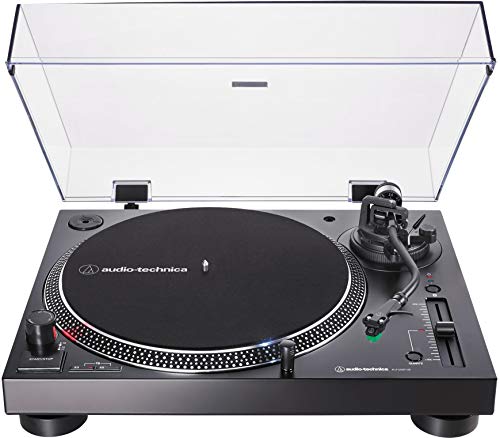
Professional Bluetooth turntable with direct-drive motor, USB output, and aptX Adaptive wireless. All the features of the LP120X plus wireless convenience. For enthusiasts who want flexibility.
The AT-LP120XBT-USB is the most versatile turntable you can buy at this price, and it's not particularly close. Audio-Technica took the chassis that made the LP120 a modern classic and bolted on every connectivity option a new vinyl listener might want.
Start with the drive. It's a direct-drive motor, the same architecture used in DJ decks and broadcast turntables, which means it reaches full speed almost instantly and holds pitch with rock-solid consistency. There's a pitch control slider and selectable 33, 45 and 78 RPM, so it plays shellac as well as modern vinyl. The tonearm is a balanced S-shape with a hydraulically damped cue lever, an adjustable counterweight, and proper anti-skate. This is a real tonearm you set up properly, not a fixed plastic arm.
The cartridge is where it connects to the rest of this site's advice: it ships with the Audio-Technica AT-VM95E, the same upgradeable cartridge I rate as the best budget platform going. If you ever want more, you pull the stylus and clip on a MicroLine without buying a new cartridge. The Nagaoka MP-110 vs AT-VM95E guide explains why that body matters.
Then the connectivity, which is the whole point. A built-in switchable phono preamp means you can plug it straight into any amplifier or powered speakers with a line input, no separate phono stage required. A USB output lets you digitise your records to a computer at 16-bit, 44.1 or 48 kHz. And Bluetooth with the Qualcomm aptX codec lets you stream wirelessly to Bluetooth speakers or headphones. For someone in a flat, or without a traditional hi-fi, that wireless option is genuinely liberating.
What you give up: a direct-drive deck with this many features can't isolate the cartridge from motor and electronic noise as completely as a stripped-back belt-drive design. The Bluetooth path, by definition, runs your analog signal through a digital codec, so audiophiles bypass it and use the wired output. And the built-in preamp, while convenient, is a budget circuit. A dedicated external phono stage will outperform it. None of these matter much until you've built a system good enough to reveal them.
Who it's right for: anyone who wants one box that handles everything, anyone digitising a record collection, anyone without a separate amp who wants to stream to powered or Bluetooth speakers, and anyone who values flexibility and the 78 RPM option. It's also the right call for a first serious deck you won't outgrow quickly, because the tonearm and cartridge are both genuinely good.
The Pro-Ject Debut Carbon EVO

Austrian-engineered turntable with carbon fibre tonearm and premium Sumiko cartridge. Exceptional performance with extensive upgrade potential. Popular choice for serious enthusiasts.
The Pro-Ject Debut Carbon EVO is the opposite philosophy. Pro-Ject took everything off the table that doesn't improve sound and spent the saved money on the parts that do. There's no Bluetooth, no USB, no built-in preamp, and no 78 RPM. What there is, is better sound.
The headline is the tonearm: 8.6 inches of woven carbon fibre, lighter and stiffer than the aluminium arms you find at this price, with a sealed, pre-adjusted bearing. The practical effect is more accurate tracking and a quieter background, especially on busy passages where a lot is happening in the groove at once. It ships with a Sumiko Rainier cartridge, a bonded elliptical that's a real step up from the budget norm and one most owners run happily for years.
The deck is belt-driven, with the motor relocated and decoupled to keep its vibration away from the platter and stylus. The platter itself is heavy MDF, chosen for its resonance behaviour. The feet are height-adjustable, so you can get the deck dead level on any shelf, which matters more for sound than people realise. At around 6 kg it sits planted and stable.
The flip side is everything it asks of you. Speed changes are manual: you lift the platter and move the belt to a different pulley groove to switch between 33 and 45. There's no preamp, so you need an amplifier with a phono input or a separate phono stage. There's no way to digitise records and no wireless. The EVO assumes you're building, or already have, a traditional hi-fi system for it to sit at the front of.
What you get for accepting all that is a cleaner, more resolving, more three-dimensional sound than the Audio-Technica produces through its wired output. On a capable system, the gap is audible. The carbon arm and Sumiko cartridge extract detail and space that the LP120XBT's good-but-busier design can't quite match.
Who it's right for: anyone whose priority is sound quality above all, who has or will buy a separate phono stage and decent speakers, who doesn't need Bluetooth, USB or 78 RPM, and who wants a deck with genuine room to grow into more serious cartridges later. It's the enthusiast's choice.
Head-to-Head
| Pro-Ject Debut Carbon EVO | Audio-Technica AT-LP120XBT-USB | Winner | |
|---|---|---|---|
| Drive | Belt (isolated motor) | Direct drive | Pro-Ject (isolation), AT (speed stability) |
| Tonearm | 8.6" carbon fibre | Balanced S-shaped aluminium | Pro-Ject |
| Included cartridge | Sumiko Rainier (elliptical) | AT-VM95E (elliptical, upgradeable) | Draw (AT upgradeable, Pro-Ject voicing) |
| Built-in phono preamp | No | Yes (switchable) | Audio-Technica |
| Bluetooth | No | Yes (Qualcomm aptX) | Audio-Technica |
| USB digitising | No | Yes (16-bit, 44.1/48 kHz) | Audio-Technica |
| Speeds | 33 / 45 | 33 / 45 / 78 | Audio-Technica |
| Speed change | Manual (move belt) | Electronic button | Audio-Technica |
| Outright analog sound quality | Higher | Good | Pro-Ject |
| Adjustable feet / levelling | Yes | Yes | Draw |
| Price | Higher | Lower | Audio-Technica |
| Best use | Dedicated hi-fi | Do-everything setup | Depends on you |
Which One Should You Buy?
Buy the Audio-Technica AT-LP120XBT-USB if:
You don't have a separate amplifier or phono stage and want to plug straight into powered speakers. You want to stream records wirelessly to a Bluetooth speaker or headphones. You want to digitise your vinyl to a computer. You play 78s, or think you might. You want a single box that handles every scenario without buying extras. You like the idea of starting with a genuinely good upgradeable cartridge and a real tonearm for less money. For the clear majority of people, this is the sensible choice.
Buy the Pro-Ject Debut Carbon EVO if:
Sound quality is your single priority and you're willing to pay more and add a phono stage to get it. You already own, or plan to own, a proper amplifier and a decent pair of speakers. You don't need Bluetooth, USB or 78 RPM and would rather that budget went into the tonearm and cartridge. You want a deck you can grow with by fitting cartridges well above the entry level. You value the carbon arm and the isolated belt drive's quieter presentation.
Buy neither if:
You want a true plug-and-play, all-in-one with speakers built in, or your budget is genuinely entry-level. In that case the best turntable under £500 guide covers simpler and cheaper options. And if you're choosing between the EVO and a higher-end audiophile deck rather than the Audio-Technica, the Rega Planar 1 vs Pro-Ject Debut Carbon EVO comparison is the more relevant fight. If you'd rather stay within the Audio-Technica direct-drive range and lose the Bluetooth and USB for a cleaner signal path, the AT-LP140XP vs LP120XBT comparison covers the purist alternative.
The Honest Case Against Each
Against the AT-LP120XBT-USB: all those features come at a sonic cost you'll eventually hear if you keep upgrading the system around it. The built-in preamp is basic and the direct-drive design isn't as quiet as a well-isolated belt deck. Bluetooth, useful as it is, routes your analog source through a digital codec. If your goal is the best possible two-channel sound and you have the amp and speakers to show it, the Audio-Technica becomes the limiting factor sooner than the Pro-Ject would. You're paying partly for features you might not use.
Against the Pro-Ject Debut Carbon EVO: the price premium is real, and so is the hidden cost of the phono stage you have to add. If you pair it with budget powered speakers and no real amplifier, you've spent more for sound quality the rest of your chain can't express, and you've lost the convenience the Audio-Technica would have given you. The manual speed change and total absence of connectivity genuinely frustrate some owners. It's a specialist's tool sold to a general audience, and not everyone who buys it actually needs what it does well.
What to Avoid
Don't buy the Pro-Ject expecting to plug it into a Bluetooth speaker or a pair of powered desktop speakers without a separate preamp. It has no built-in phono stage, and people are regularly caught out by this, getting almost no sound and assuming the deck is faulty. Budget for a phono stage alongside it, or buy the Audio-Technica instead.
Equally, don't buy the Audio-Technica if your real goal is maximum fidelity on a serious system, then spend the next year frustrated that it's the weak link. Match the deck to the system you actually have or are genuinely committed to building.
And avoid the trap of buying either of these and pairing it with a cheap all-in-one speaker. Both decks deserve, at minimum, a competent pair of powered bookshelf speakers. The turntable is only ever as good as what comes after it.
Owner Community Consensus
The forum split on these two maps almost exactly onto the features-versus-fidelity divide, and reading through r/vinyl, Steve Hoffman and the Audio-Technica owner threads, the same patterns come up again and again.
LP120XBT-USB owners talk about it as the deck that got them properly into vinyl without forcing a hi-fi purchase first. The most repeated praise is the sheer convenience: plug into anything, stream to the kitchen speaker, rip a rare record to digital, all without buying a single extra box. The honest, recurring caveat from longer-term owners is that once they upgraded their speakers or amp, they started to hear the limits of the built-in preamp and the busier direct-drive presentation, and some eventually added an external phono stage to bypass it. Nobody regrets buying it as a first deck; the regret, where it appears, is from people who needed an audiophile source and bought a Swiss Army knife.
Debut Carbon EVO owners describe the opposite arc. The setup takes more effort, the missing preamp catches a few people out, and the manual speed change draws mild grumbles. But owners who pair it with a real system consistently describe a clear step up in clarity and soundstage over feature-laden decks at similar money, and very few feel the need to upgrade the deck itself for years. The phrase that recurs is that it disappears: you stop thinking about the turntable and just hear the record.
The most useful summary from people who've owned both: the Audio-Technica is the deck you recommend to a friend starting out, and the Pro-Ject is the one you keep once you know exactly what you want.
FAQ
Is the Pro-Ject Debut Carbon EVO better than the AT-LP120XBT-USB? For outright analog sound quality on a capable system, yes. The carbon tonearm, Sumiko cartridge and isolated belt drive give it a cleaner, more detailed presentation. But the Audio-Technica is more versatile and better value, with a built-in preamp, Bluetooth, USB and 78 RPM. Better depends on whether you prioritise sound or features.
Does the AT-LP120XBT-USB need a separate phono preamp? No. It has a built-in switchable phono preamp, so you can connect it directly to any amplifier or powered speakers with a line input, or stream over Bluetooth. The Pro-Ject Debut Carbon EVO has no preamp and does require either an amplifier with a phono input or a separate phono stage.
Can the Pro-Ject Debut Carbon EVO connect to Bluetooth speakers? No. The EVO is a pure analog turntable with no Bluetooth, USB or wireless of any kind. If wireless streaming to a Bluetooth speaker matters to you, the AT-LP120XBT-USB is the one to buy. The Pro-Ject assumes a wired hi-fi system.
Which cartridge is better, the Sumiko Rainier or the AT-VM95E? Both are bonded elliptical cartridges and both are good. The Sumiko Rainier has a slightly fuller voicing; the AT-VM95E's advantage is that the same body accepts higher styli, so you can upgrade it cheaply later. For long-term flexibility the VM95E platform wins; for out-of-the-box character the two are close.
Can I digitise my records with these turntables? Only with the Audio-Technica. Its USB output records vinyl to a computer at 16-bit, 44.1 or 48 kHz, which is one of the main reasons to choose it. The Pro-Ject Debut Carbon EVO has no USB and cannot digitise without separate hardware.
What I'd Buy Today
For most people reading this, the Audio-Technica AT-LP120XBT-USB. It costs less, it removes every obstacle to getting started, and it grows with you: a real S-shaped tonearm, the upgradeable VM95E cartridge, a built-in preamp so you can plug into anything, plus Bluetooth, USB and 78 RPM for the times you need them. It's the turntable that says yes to whatever your setup happens to be.
If sound quality is the only thing you care about, and you have, or are committed to building, a proper amplifier and speakers with a phono stage, spend the extra on the Pro-Ject Debut Carbon EVO. The carbon arm and Sumiko cartridge give you a genuinely better listen, and it's a deck you can keep improving for years. Just go in knowing you'll need a phono stage to make it sing.
As an Amazon Associate, we earn from qualifying purchases.
Products Mentioned in This Guide
Find Your Perfect Setup
Answer a few quick questions and get personalised recommendations.
Start the QuizFrequently Asked Questions
Is the Pro-Ject Debut Carbon EVO better than the AT-LP120XBT-USB?
For outright analog sound quality on a capable system, yes. The carbon tonearm, Sumiko cartridge and isolated belt drive give it a cleaner, more detailed presentation. But the Audio-Technica is more versatile and better value, with a built-in preamp, Bluetooth, USB and 78 RPM. Better depends on whether you prioritise sound or features.
Does the AT-LP120XBT-USB need a separate phono preamp?
No. It has a built-in switchable phono preamp, so you can connect it directly to any amplifier or powered speakers with a line input, or stream over Bluetooth. The Pro-Ject Debut Carbon EVO has no preamp and requires either an amplifier with a phono input or a separate phono stage.
Can the Pro-Ject Debut Carbon EVO connect to Bluetooth speakers?
No. The EVO is a pure analog turntable with no Bluetooth, USB or wireless of any kind. If wireless streaming matters to you, the AT-LP120XBT-USB is the one to buy. The Pro-Ject assumes a wired hi-fi system.
Which cartridge is better, the Sumiko Rainier or the AT-VM95E?
Both are bonded elliptical cartridges and both are good. The Sumiko Rainier has a slightly fuller voicing; the AT-VM95E's advantage is that the same body accepts higher styli, so you can upgrade it cheaply later. For long-term flexibility the VM95E platform wins; for out-of-the-box character the two are close.
Can I digitise my records with these turntables?
Only with the Audio-Technica. Its USB output records vinyl to a computer at 16-bit, 44.1 or 48 kHz, which is one of the main reasons to choose it. The Pro-Ject Debut Carbon EVO has no USB and cannot digitise without separate hardware.
Related Guides
Best Turntables Under £500 UK 2026: Rega vs Pro-Ject vs Audio-Technica vs Sony
ComparisonRega Planar 1 vs Pro-Ject Debut Carbon EVO 2026: Which Should You Buy?
Setup GuideTurntable Cartridge Upgrade Guide UK 2026 | From £50
Buying GuideBest Record Players UK 2026: Expert Picks at Every Budget
ComparisonAudio-Technica LP60X vs LP120X UK 2026 | £120 vs £270
Ready to find your perfect setup?
Our quiz matches you with the right turntable, speakers, and accessories.
Take the Quiz - It's FreeNo email required