Turntable Cartridge Upgrade Guide 2026 | From $59

Vinyl collector for over thirty years. Found my first turntable and a box of records in the loft at twelve — Nashville Skyline, After the Gold Rush, Disraeli Gears. Still spinning on a vintage Sony PS-X600.
Just so you know, some links on this page are affiliate links. If you buy something via them, we get a small kickback. You don't pay more, but it helps toward the next record.
The cartridge is the single component most directly responsible for what you hear from vinyl. It translates the microscopic groove modulations into an electrical signal, a better one with a precisely shaped stylus extracts more of that signal accurately. My pick for most people upgrading a mid-range US turntable: the Nagaoka MP-110. Warm, musical, and the recommendation that keeps coming up in every serious vinyl community when someone asks what to put on an AT-LP120X first.
Quick Picks
Not sure which setup is right for you?
Take Our QuizPrices checked May 2026.
When to Upgrade
Don't upgrade right away. Get used to your turntable first. Learn what it sounds like. Figure out what you'd want improved. Then consider whether a cartridge swap addresses that.
Good reasons to upgrade: - Your turntable cost $300+ and came with a basic cartridge - You've upgraded speakers and still want more - Your current stylus is worn and you're replacing anyway - You want a different sound character (warmer, brighter, more detailed)
Poor reasons to upgrade: - You just bought the turntable and Reddit said to upgrade - You haven't upgraded speakers yet - You're chasing "audiophile" status instead of actual improvement
Compatibility Check
Not all turntables accept cartridge upgrades. The Audio-Technica AT-LP60X has a fixed cartridge, you can replace the stylus but not the cartridge itself.
Turntables with removable headshells (AT-LP120X) or standard half-inch mounting (Rega, Pro-Ject) accept aftermarket cartridges. Check your turntable's specifications before shopping.
Budget Upgrades
Audio-Technica VM95E: clean, detailed sound. Part of a series with upgradeable styluses, you can improve later by swapping just the stylus (VM95EN, VM95ML, VM95 Shibata) without buying a whole new cartridge. The VM95 body is the smartest entry point if you want a long-term upgrade path built in from day one. Check Price on Amazon

Best budget cartridge, clean sound, upgradeable stylus path from the stock elliptical to Shibata
Ortofon 2M Red: the classic first upgrade recommendation. Improved clarity, detail, and dynamics over stock cartridges. Easy to install and forgiving of minor setup imperfections. Worth buying specifically if you plan to upgrade the stylus to 2M Blue later, the Blue stylus fits the Red body.
Nagaoka MP-110: warm, musical sound with a dedicated following in the vinyl community. Rock and jazz records come alive with this one. If I had to pick a single upgrade cartridge for a mid-range turntable, this is it. Check Price on Amazon
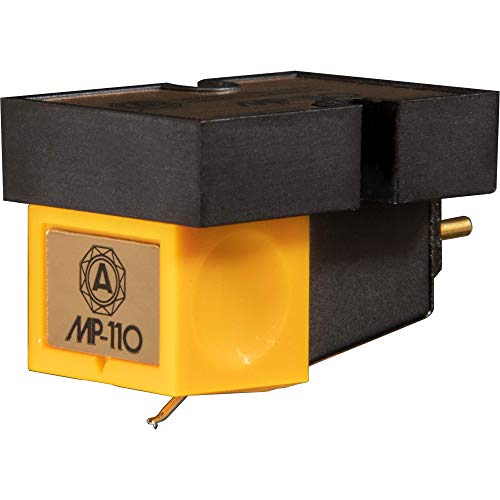
Best overall upgrade, warm, musical, transforms rock and jazz on any capable tonearm
Mid-Range Upgrades: $100-$300
Ortofon 2M Blue: significant step up from the Red. Nude elliptical stylus reveals detail you didn't know was in your records. Inner-groove distortion, the blurring that affects loud passages near the label, drops noticeably. Worth it when your speakers can resolve the difference.
Audio-Technica VM540ML: MicroLine stylus tracks with remarkable precision. Less record wear than elliptical tips over time. Detailed, analytical sound that rewards well-mastered records. Check Price on Amazon
Nagaoka MP-200: refined version of the MP-110's warm character with better detail retrieval. Vinyl listeners who prioritize musical engagement over clinical accuracy land here. The improvement over the MP-110 is real but requires a capable system, a Rega Planar 2 or better with speakers at $300+ to reveal the difference clearly. Check Price on Amazon
Honest note on the 2M Red: at its price the Nagaoka MP-110 competes directly, and most listeners prefer the MP-110's warmer character. The 2M Red makes most sense as a stepping stone to the 2M Blue stylus upgrade rather than as a final destination.
Premium: $300+
At this level, consider whether your turntable deserves the investment. An Ortofon 2M Bronze on an AT-LP120X will improve the sound, but you're approaching the limits of what the tonearm and motor can reveal. Better results come from upgrading the turntable first, then matching it with a premium cartridge.
If you own a Rega Planar 2, Rega Planar 3, or Pro-Ject Debut Carbon EVO, premium cartridges make clear sense. The tonearm bearing quality and motor stability in those turntables can translate what the cartridge extracts. A Nagaoka MP-200 or Ortofon 2M Bronze on a Rega Planar 2 is a genuinely well-matched combination.
Stylus Types: What the Shapes Mean
When comparing cartridges, you'll encounter stylus shape descriptions. These matter because the shape determines how precisely the stylus tracks the groove modulations.
Conical (spherical). The simplest shape. A round ball that contacts the groove wall at a relatively large surface area. Tracks reasonably well but misses fine high-frequency detail. Common on budget and replacement styluses. Forgiving of worn records and alignment errors.
Elliptical. Standard on most quality cartridges. A longer contact patch than conical, which means more accurate tracking at higher frequencies. The Nagaoka MP-110, Ortofon 2M Red, and Audio-Technica VM95E all use elliptical styluses. This is the right shape for most first-time upgraders.
Microlinear (fine-line). Even thinner contact patch than elliptical. Tracks groove modulations more precisely, extracts more high-frequency detail, and produces less record wear over time. The Audio-Technica VM95ML and Ortofon 2M Blue use this profile. Audibly better than elliptical on capable systems, inner-groove distortion in particular reduces noticeably.
Shibata and line-contact. Developed for quadraphonic records in the 1970s, now found on premium cartridges. The narrowest contact patch. Maximum detail extraction and minimum record wear, but sensitive to precise alignment, these punish setup errors more than elliptical types.
For most people upgrading for the first time: elliptical is the right choice. The Nagaoka MP-110 and Ortofon 2M Red represent the practical sweet spot.
How to Know Your Stylus Is Worn
A stylus typically lasts 500 to 1000 hours. Signs it needs replacing:
Increased surface noise. Records that used to play quietly now have more hiss, crackle, or grain. A worn stylus tip develops flat spots that don't track the groove cleanly.
Distortion on vocal peaks and cymbal crashes. High-frequency groove modulations are the first to suffer under a worn stylus. Sibilant sounds, the 's' in vocals, distort first. If records sound slightly harsh on acoustic guitar or female vocals, this is often the cause.
Mistracking. The stylus skips or loses contact with the groove on loud passages, particularly bass-heavy sections and drum hits.
Visible damage. Under a loupe or phone camera macro mode, a new stylus shows a smooth polished point; a worn one shows flat facets or rounding.
If any of these apply, replace the stylus before considering a full cartridge upgrade. A worn stylus on an excellent cartridge sounds worse than a new stylus on a budget one.
Setting Up a New Cartridge
After mounting a new cartridge, two adjustments are essential for turntables with adjustable tonearms, the AT-LP120X, Rega, and Pro-Ject range. These do not apply to the AT-LP60X, which has a fixed non-adjustable setup.
Tracking force. The manufacturer specifies a range. The Nagaoka MP-110's range is 1.5 to 2.0 grams, recommended 1.8g. Use the counterweight at the back of the tonearm to set this. Too light causes mistracking and skipping; too heavy causes accelerated groove wear. A digital stylus force gauge costs around $15-20 and removes the guesswork, worth buying once.
Anti-skate. The tonearm naturally pulls inward across the record due to stylus drag. Anti-skate applies a counterforce. Set it roughly equal to your tracking force. Getting this right reduces inner-groove distortion and prevents uneven wear between stereo channels over thousands of plays.
Alignment. Check that the cartridge aligns correctly at both null points using the protractor. Most cartridges include a basic protractor; free Baerwald or Stevenson alignment templates available online produce more accurate results. Small alignment errors cause audible distortion on one side of the stereo image.
Installation for removable headshell turntables (AT-LP120X):
1. Remove the headshell from the tonearm 2. Unclip the four color-coded wires from the old cartridge 3. Unscrew the old cartridge 4. Mount the new cartridge, connect wires (red, green, blue, white, colors match) 5. Align using the included protractor 6. Reattach headshell and set tracking force per the new cartridge's specs
Expect 30-60 minutes your first time. Turntable Lab, Crutchfield, and many local hi-fi stores will install for $25-$40 if you'd prefer not to DIY.
The Break-In Period
A new cartridge doesn't immediately perform at its best. The suspension, the elastic material that allows the cantilever to move, needs time to settle. Most manufacturers specify 20 to 40 hours of playing time before the cartridge reaches optimal performance.
During break-in: play records normally. Don't start with your best pressings. The sound will be slightly stiff initially, less bass, a slightly hard quality to high frequencies. After 20 hours, it loosens into its character. After 40 hours, you're hearing what the cartridge can actually do.
If you compare a new cartridge to your old one immediately after installation and aren't sure it's better: give it 20 hours before deciding.
Is the Upgrade Worth It?
Upgrading from a stock cartridge to a Nagaoka MP-110 on a $300 turntable with decent speakers? You'll hear a clear difference, more detail, better imaging, warmer character on rock and jazz.
Same upgrade on a $150 turntable with $60 desktop speakers? The cartridge is extracting more detail from the groove, but the speakers can't reproduce it. Like upgrading to a 4K camera and watching on a standard-definition screen.
A rough practical guide: cartridge and speakers should be roughly balanced in quality. A $99 cartridge deserves $150+ powered speakers. A $250 cartridge deserves $300+ speakers. Upgrade the weakest link first, and in most beginner vinyl setups, the weakest link is the speakers.
What to Avoid
Budget no-name cartridges. Unbranded cartridges sold as upgrades on Amazon for under $20 are consistently ceramic or very low-grade magnetic. They track at excessive force, damage groove walls over time, and produce muddy, congested sound. The savings are not real. Stick to Nagaoka, Audio-Technica, or Ortofon.
Mismatched upgrades. A $449 Ortofon 2M Bronze on an AT-LP60X is a wasted investment, the fixed headshell and budget tonearm can't reveal what that cartridge offers. Match cartridge budget to turntable quality. Spend too far ahead of your turntable and you'll hear frustratingly little improvement for the money.
Upgrading before speakers. Speakers are almost always the biggest sonic bottleneck in beginner vinyl setups. If your speakers are $50 desktop models, a cartridge upgrade produces a smaller improvement than upgrading speakers first. Fix the weakest link.
Buying without checking compatibility. The AT-LP60X, many Crosley models, and some budget turntables have fixed or proprietary mounts that don't accept standard half-inch cartridges. Always verify your tonearm accepts standard half-inch mounting before ordering.
Frequently Asked Questions
Can I use any cartridge on my turntable? No. Your turntable must have standard half-inch cartridge mounting. The AT-LP120X accepts most half-inch cartridges. The AT-LP60X has a fixed cartridge body, only compatible replacement styluses work. Rega and Pro-Ject turntables use standard half-inch and accept most aftermarket cartridges.
Does cartridge brand matter? Ortofon, Audio-Technica, and Nagaoka are the three most recommended brands under $250. They have consistent quality control, good US customer support, and well-documented performance. At higher price points, Dynavector, Clearaudio, and Lyra are well regarded.
Will a better cartridge damage my records less? Modern quality cartridges from any reputable manufacturer track at 1.5 to 2.5 grams and cause minimal groove damage. Upgrading from a worn or cheap budget stylus to a quality replacement reduces groove wear. The biggest ongoing risk to records is a worn stylus tip, not the cartridge brand.
How do I know if my current cartridge is decent? Turntables that shipped with an Audio-Technica VM95E, Ortofon 2M Red, or Nagaoka MP-110 have good cartridges already. Those with unbranded AT3600L or basic ceramic cartridges benefit most from upgrading. Check your turntable's manual or the manufacturer spec page for the included cartridge model.
Can I upgrade to a moving coil (MC) cartridge? Yes, if your phono preamp supports MC. MC cartridges have lower output voltage and require higher gain and different impedance loading than MM cartridges. Most budget turntables have MM-only internal preamps. If upgrading to MC, you'll also need an MC-capable phono preamp, the Schiit Mani 2 at around $149 handles both. This is a system upgrade, not just a cartridge swap.
What I'd Buy Today
The Nagaoka MP-110 is my recommendation for almost any mid-range turntable upgrade. Around $99, elliptical stylus, warm and musical character that works particularly well on rock, jazz, and acoustic recordings. It transforms a stock AT-LP120X in a way that's immediately audible on the first side you play.
Get the Nagaoka MP-110 on Amazon
If you want a long-term upgrade path built in from day one, the Audio-Technica VM95E is the smarter structural choice: the same cartridge body accepts VM95EN, VM95ML, and VM95 Shibata styluses as your system develops. Buy the body once, upgrade the stylus over the years without ever replacing the cartridge.
A cartridge upgrade at the right time in the right system is one of the most satisfying improvements in vinyl. Not because it's expensive or complicated, because it's direct. You're improving the component that reads the record. Everything upstream was already there. A better stylus is just a better key to the same music.
For the complete system picture, see our record player setup guide and phono preamp guide.
The practical test for whether you're ready to upgrade: put on a record you know well and listen specifically to the midrange on a quiet passage, vocals, acoustic guitar, piano. If the sound feels slightly congested or lacks separation between instruments, a cartridge upgrade will improve it. If the sound already feels open and distinct, the bottleneck is elsewhere, likely speakers or room placement. A cartridge upgrade is only as good as the chain it feeds into.
Stylus vs Cartridge Replacement
Sometimes you only need a new stylus, not a full cartridge. Stylus tips wear out; cartridge bodies last much longer if the suspension stays healthy.
Replacement styluses cost less than new cartridges. An Ortofon 2M Red replacement stylus costs around $69, less than a new 2M Red cartridge. If you're happy with your cartridge's overall character but notice the signs of stylus wear, replace the stylus tip first before spending on a new cartridge.
The upgrade path works both ways. The 2M Blue stylus fits the 2M Red body, so Red owners can step up to Blue-level performance without buying a complete new cartridge. The Audio-Technica VM95 series works the same way: any stylus in the range fits any VM95 body, from the $39 VM95C conical up to the $399 VM95 Shibata. Buy the body once and upgrade the stylus as your system and ears develop.
Where to buy in the US: Amazon has the widest selection and fastest delivery. Turntable Lab and Crutchfield offer expert advice and will answer installation questions before and after purchase, useful for first-time cartridge buyers who want guidance on compatibility and setup. LPGear.com specializes in cartridges and styluses, with detailed compatibility guides and particularly strong support for finding replacement styluses for older cartridges. Many local hi-fi stores and Best Buy Magnolia locations will do installation checks; most can complete it while you wait for $25-40, which removes the guesswork from first-time cartridge mounting entirely.
What You'll Need With It
The Ortofon 2M Red is the standard reference comparison for entry-level cartridge upgrades. Brighter and more forward-sounding than the Nagaoka MP-110, with a stylus that upgrades to 2M Blue performance without replacing the cartridge body. Some listeners prefer its character on rock and more forward-sounding recordings.

Legendary MM cartridge delivering warm, musical sound with excellent detail. The benchmark for mid-range cartridges. Massive improvement over stock cartridges on Rega and Pro-Ject decks.
Set tracking force precisely after fitting any new cartridge. This gauge reads to 0.01g and the check takes two minutes. Correct tracking force is what lets a quality cartridge perform as designed: at the wrong weight, a $100 cartridge sounds like a $30 one.

Accurate digital gauge ensuring optimal tracking force for cartridge longevity and sound quality. LCD display with 0.01g precision. Essential tool for turntable setup.
Find Your Perfect Setup
Answer a few quick questions and get personalised recommendations.
Start the QuizFrequently Asked Questions
When should I upgrade my turntable cartridge?
Upgrade when: (1) your turntable cost $300+ and came with a basic cartridge, (2) you have upgraded your speakers/amplifier and the turntable is the weak link, (3) you want to try a different sound signature (warmer, brighter, more detailed), or (4) your current cartridge is over 5 years old or the stylus has 1000+ hours of use.
What is the best budget cartridge upgrade?
The Ortofon 2M Red is the classic upgrade for turntables like the Audio-Technica AT-LP120X and Pro-Ject Debut. It offers improved clarity, detail, and dynamics over stock cartridges. The Audio-Technica VM95EN is another excellent budget option with a refined, smooth sound.
What is the difference between MM and MC cartridges?
MM (Moving Magnet) cartridges are common, affordable ($59-$400), and work with standard phono preamps. MC (Moving Coil) cartridges offer better performance ($250-$2500+) but require a specialized MC phono preamp or step-up transformer. For most users, high-end MM cartridges like the Ortofon 2M Blue are the sweet spot.
Can I install a cartridge myself?
Yes, if your turntable has a removable headshell (like the AT-LP120X), it is straightforward - align the cartridge using the supplied protractor, connect four color-coded wires, and set the tracking force. Fixed headshell turntables require more care aligning and mounting. Expect 30-60 minutes for your first installation. Many hi-fi shops offer installation for $25-40.
Related Guides
Best Turntables Under $500 2026: Rega vs Pro-Ject vs Audio-Technica
How-ToPhono Preamp Guide 2026 | Do You Need One? From $39
Setup GuideHow to Set Up a Record Player 2026 | Step-by-Step
ComparisonAudio-Technica LP60X vs LP120X 2026 | Which to Buy
Setup GuideTurntable Cartridge Upgrade Guide UK 2026 | From £50
Ready to find your perfect setup?
Our quiz matches you with the right turntable, speakers, and accessories.
Take the Quiz - It's FreeNo email required