Best Speakers for Turntables 2026 | From $99 to $500

Vinyl collector for over thirty years. Found my first turntable and a box of records in the loft at twelve — Nashville Skyline, After the Gold Rush, Disraeli Gears. Still spinning on a vintage Sony PS-X600.
Just so you know, some links on this page are affiliate links. If you buy something via them, we get a small kickback. You don't pay more, but it helps toward the next record.
Most people buying their first turntable connect it to whatever speakers they already own. A Bluetooth speaker. A soundbar. Laptop speakers. Then they wonder why vinyl doesn't sound like they expected.
Speakers are where the music actually happens. The turntable converts groove to electrical signal. The speakers convert that signal to sound. Everything in between serves those two endpoints. Get the speakers right and even a modest turntable sounds like it cost twice as much.
The right answer for most US buyers starting out is the Edifier R1280T. Warm, musical, and well-matched to vinyl's character. If you want to know why, and when to spend more or less, read on. And if you're still choosing the turntable itself, our best turntables under $500 guide covers the decks these speakers pair with best.
Quick Picks
Not sure which setup is right for you?
Take Our QuizPrices checked April 2026.
Active vs Passive: The Key Decision First
Active (powered) speakers have a built-in amplifier. Plug in your turntable and they work. No separate amplifier to buy, configure, or wire.
Passive speakers have no amplifier. They need a separate integrated amplifier or stereo receiver. More flexibility, more upgrade potential, more complexity.
For anyone new to vinyl: choose active speakers. Every recommendation in this guide is active. If you already own a receiver, from a home theater system, or a vintage stereo receiver from Craigslist, passive bookshelf speakers from Polk Audio, Klipsch, or Q Acoustics are worth exploring.
Connection point: if your turntable has a built-in phono preamp (AT-LP60X, AT-LP120X, and most modern turntables do), there is a LINE/PHONO switch on the back. Set it to LINE before connecting to powered speakers. LINE is the correct signal level for a speaker input. PHONO is too small, you'll hear something, but it will be quiet and thin.
Budget Active Speakers: Around $80-$150
Edifier R1280T
The standard recommendation for budget vinyl across r/vinyl, r/BudgetAudiophile, and most audio forums that haven't been paid to say otherwise. Wood veneer cabinets, 4-inch woofers, 13mm tweeters, 42 watts total. Sound character is warm and musical, the Edifiers complement vinyl's natural mid-range emphasis without fighting it. Bass is present and satisfying for small rooms; it doesn't move air, but it's there.
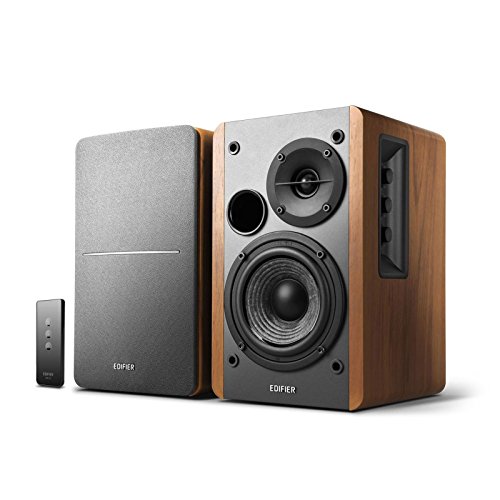
Best budget speakers for vinyl, warm sound, great value, wood veneer
Who this is right for: anyone pairing with an AT-LP60X or similar beginner turntable, bedroom and small living room setups, anyone who wants to spend under $100 on speakers without compromising how their records are reproduced.
The honest limitation: the R1280T's bass drops off meaningfully below around 60Hz. Double bass, kick drums, and bass guitar are present but not authoritative. In a small room this matters less; in a larger space you notice what's missing at higher volumes. The controls are on the rear of the right speaker, which is slightly awkward once positioned.
Edifier R1280DB
Same drivers and sound as the R1280T, with Bluetooth and optical input added. Sound quality through wired connection is functionally identical. The upgrade makes sense if you want these speakers to double for TV audio or phone streaming. For better than phone streaming, a dedicated music streamer feeds them lossless audio over your network. If vinyl is your only source, save $30 and get the R1280T.
PreSonus Eris E3.5
A different character from the Edifiers. Where the Edifiers are warm and musical, the Eris E3.5 are flat and accurate, designed for studio monitor work. They reveal exactly what's on the record without adding warmth or softening edges. Whether that is better depends on your preferences.
Who this is for: listeners who want accuracy over colouration, anyone using the speakers for music production or home studio work alongside vinyl, near-field desktop listening. Who it is not for: anyone who finds digital sound clinical and came to vinyl specifically for warmth. The Eris will reproduce what is on the record accurately, it adds nothing extra.
Mid-Range Active Speakers: Around $150-$400
Edifier R1700BT
A meaningful step up. 66 watts total, 5-inch woofers, bass that genuinely reaches low enough to feel on bass-heavy records. Jazz upright bass, rock kick drums, and bass guitar carry real weight. Medium living rooms fill without strain. Bluetooth is built in.

Best mid-range speakers, more power, deeper bass, Bluetooth built in
Who this is right for: rooms between 150 and 250 square feet, listeners with records that have real low-end (rock, jazz, classical, electronic), anyone who found the R1280T lacking at medium-to-loud volumes.
The honest limitation: the tweeter placement makes positioning height matter more than with the R1280T. At ear level these deliver well; too high or too low and the treble detail becomes recessed.
Audioengine A2+
Compact in size, substantial in sound. Clean and controlled character, the A2+ is built in Austin, Texas and has a loyal following for pairing vinyl with computer audio setups. USB input, front-panel volume knob, notably better build quality than the Edifiers.
Who this is right for: desk setups and near-field listening, listeners using the same speakers for vinyl and computer audio, buyers who value build quality and aesthetics.
The honest limitation: at this price, a separate integrated amplifier and passive bookshelf speakers can be competitive. The Emotiva BasX A-100 driving Polk Audio Signature Elite ES15 speakers beats it on soundstage and dynamics. The A2+ wins on simplicity and size.
Kanto YU4
Built-in phono stage means turntables without internal preamps, Rega Planar 1, Pro-Ject Debut Carbon, connect directly without additional equipment. Bluetooth, subwoofer output, remote control, and sound quality that matches the price. Kanto is a Vancouver-based company with strong US retail presence and a consistent track record on enthusiast forums.
The Premium Option: Klipsch The Fives
At the top of this range, the Klipsch The Fives are a different class of powered speaker. Built-in PHONO input accepts turntable signal directly. The 5.25-inch woofer delivers real bass authority, these move air in a way bookshelf speakers at lower prices cannot. The horn-loaded tweeter gives efficiency and detail that most powered speakers lack at any price.
If you are pairing with a Rega, Pro-Ject, or any turntable without a built-in preamp, The Fives simplify setup considerably. If you expect to grow into a better turntable over time, the speakers will not be the limiting factor for years.
The honest limitation: at this price, you are in territory where a quality integrated amplifier and passive bookshelf speakers from Klipsch or Wharfedale starts to compete. The Fives win on convenience and integrated design; separates win on long-term flexibility and often on soundstage.
What to Avoid
Unbranded Amazon speakers. Listings with no recognisable brand and implausible specifications, "200W" for a speaker at bargain-bin prices. Poor drivers, resonant cabinets, frequency response boosted in the mid-bass for perceived warmth. Your records will sound worse than through laptop speakers.
Bluetooth-only speakers not designed for line-level input. A JBL Flip or Bose SoundLink is a good Bluetooth speaker. As a destination for a turntable's wired RCA output, it typically isn't designed for this, no line-level RCA input. For wireless vinyl, use a turntable with Bluetooth output (Sony PS-LX310BT) or speakers with both RCA and Bluetooth inputs (Edifier R1280DB, R1700BT).
Soundbars. Designed for TV dialogue and surround formats. Terrible for stereo music, the image collapses to a horizontal smear. Records deserve better.
Cheap "multimedia" speaker sets under $50. Below this price, driver quality and cabinet construction drop below the level where vinyl sounds like vinyl. Bass is absent, the frequency response is too narrow, and the sound is fatiguing rather than musical.
Buyer's Guide: What Actually Matters
Driver size. Larger woofers move more air and reproduce bass more convincingly. The R1280T's 4-inch woofers suit small rooms. The R1700BT's 5-inch woofers handle medium rooms. For large rooms, consider the Klipsch The Fives or a passive system with a proper amplifier.
Phono input. If your turntable has no built-in phono preamp, or you want to bypass the internal one, look for speakers with a dedicated PHONO input (Klipsch The Fives, Kanto YU4), or add a standalone phono stage. The ART DJ Pre II and Pro-Ject Phono Box E are reliable options.
Room size. Small rooms under 150 square feet, R1280T is adequate. Medium rooms from 150 to 250 square feet, R1700BT or Audioengine A2+. Larger spaces or open plan, Klipsch The Fives, passive speakers with an integrated amp, or add a subwoofer via the Kanto YU4's subwoofer output.
The matching rule. Spend roughly equal amounts on turntable and speakers. A $200 turntable through $200 speakers typically sounds better than a $349 turntable through $50 speakers. If you already own decent speakers, put more into the turntable.
Placement: More Important Than Most People Think
A $100 speaker positioned correctly outperforms a $300 speaker in a bad position. Position at ear level when seated. Angle toward your listening position. Form a rough equilateral triangle between your head and the two speakers.
Avoid corners, corner placement boosts bass through room boundary reinforcement, which sounds good briefly and becomes boomy quickly. Against a flat wall is fine.
Don't place speakers on the same surface as your turntable. Vibrations transfer and muddy the sound. Use a separate shelf, stands, or isolation pads between speakers and furniture.
Frequently Asked Questions
Do I need a phono preamp if my turntable already has one? No. Set the turntable's LINE/PHONO switch to LINE and connect directly to the speaker's RCA input. You need a separate phono stage only if your turntable has none built in, like most Rega or Pro-Ject models, or if you want to replace the internal preamp with a higher-quality external unit.
Can we use my home theater receiver's existing speakers with a turntable? Yes, if the receiver has a PHONO input. Connect the turntable to PHONO, not to a line input. If the receiver has no PHONO input, add a standalone phono stage between turntable and receiver's AUX or line input.
Will Bluetooth speakers work with a turntable? Only if the turntable has Bluetooth output (Sony PS-LX310BT, PS-LX5BT) or the speaker has a wired line-level RCA input. Most Bluetooth speakers only receive Bluetooth. For wireless vinyl, look for speakers with both RCA and Bluetooth, the Edifier R1280DB and R1700BT have this.
Is there a meaningful difference between the R1280T and R1700BT? Yes. The R1700BT has notably more bass extension and output. In a small bedroom the difference is marginal. In a medium living room the R1700BT fills the space where the R1280T sounds thin at higher volumes. The extra $80 is worthwhile if your room is larger than a bedroom or if your records include anything with real low-end.
Do I need a subwoofer for vinyl? Probably not. Records have limited bass extension compared to digital sources, and good bookshelf speakers handle vinyl bass adequately. A subwoofer adds impact on bass-heavy records in larger rooms, if that matters to you, look at the Kanto YU4 which has a dedicated subwoofer output, or the Klipsch The Fives which pair naturally with the Klipsch R-8SW subwoofer. Most vinyl listeners don't need one, but bass-heavy genres like hip-hop, electronic, and reggae benefit in larger spaces.
What's a good starting budget for the whole vinyl setup? The entry pairing covers the AT-LP60X turntable and Edifier R1280T speakers, a complete, properly functioning setup. Add around $20 for a carbon fibre record brush and you have everything you need. The $530 mid-range setup (AT-LP120X plus R1700BT) is worth it if you know you'll want to upgrade the cartridge eventually or if your room is larger than a bedroom.
Recommended Pairings
Budget setup (AT-LP60X): Edifier R1280T. A complete budget pairing, simple, sounds like vinyl should.
Mid-range setup (AT-LP120X): Edifier R1700BT or Kanto YU4. Better dynamics, more presence in larger rooms.
Audiophile setup (Rega Planar 1 or Pro-Ject Debut Carbon): consider passive bookshelf speakers with a proper integrated amplifier, the Emotiva BasX A-100, NAD C316BEE, or Cambridge Audio AXA35. Alternatively, the Klipsch The Fives handle everything in one unit with a built-in phono stage.
For a complete setup guide covering turntable and speaker selection together, see our turntable with speakers US guide.
Get the speakers right and even a modest turntable sounds like it should have cost twice as much. That is acoustics, and it is one of vinyl's real pleasures.
Speaker Stands and Isolation
Most people put speakers on the furniture they already own. This works. Dedicated speaker stands improve things noticeably at every price point.
The benefit is twofold. Stands position speakers at ear level regardless of furniture height, this matters more than most buyers expect, particularly for speakers like the R1700BT where tweeter height affects treble detail. Stands also decouple speakers from floor or shelf vibrations that would otherwise muddy the bass.
Cable quality: what actually matters
Speaker cable quality matters less than cable length and gauge. For runs under 10 feet, basic 16-gauge speaker wire from Amazon or a hardware store is sufficient. For longer runs, use 14-gauge to prevent signal loss. Expensive audiophile cables provide no measurable benefit at typical home listening distances. The same applies to RCA interconnects: a $10 cable from Amazon carries the same signal as a $100 cable from an audiophile brand. Save the money for better speakers.
One exception: if you experience interference or hum, shielded RCA cables can reduce noise pickup. But this is a problem-solving purchase, not a preemptive upgrade. Buy basic cables first and only upgrade if you hear a specific issue.
Speaker break-in: real or myth
New speakers may sound slightly different after 20-50 hours of use as the driver suspension loosens slightly. The change is subtle and not universally agreed upon among audio engineers. Do not buy speakers expecting them to sound dramatically different after break-in. If they sound bad new, they will sound bad later. Choose speakers that sound good to you from the first listening session. Room acoustics: the free upgrade
Speaker placement and room treatment make a bigger difference than most people realise. Before spending money on better speakers, try these zero-cost adjustments. Pull speakers at least 12 inches from the back wall. Bass builds up when speakers sit close to walls, creating a boomy, undefined low end. Angle speakers inward so they point toward your listening position (this is called toe-in). The stereo image tightens immediately.
If your room has hard floors and bare walls, sound reflections create a harsh, echoey quality that no speaker upgrade fixes. A rug between you and the speakers, curtains on windows, and a bookshelf on a side wall all absorb reflections and improve clarity. These basic acoustic treatments cost nothing if you already own these items and transform the listening experience more than upgrading from $200 speakers to $400 speakers.
Passive vs powered speakers for vinyl
Powered (active) speakers have a built-in amplifier. Connect them directly to your turntable's preamp output and they play. No separate amplifier needed. This simplicity makes them the default recommendation for people building their first vinyl setup.
Passive speakers require a separate amplifier or receiver. This adds cost and complexity but gives you more control. You choose the amplifier and speakers independently, upgrade either component separately, and have more options at every price point. For a first turntable setup, powered speakers keep things simple. For someone building a dedicated listening space, passive speakers with a quality amplifier eventually provide more control and upgradeability.
Subwoofer: when to add one
Bookshelf speakers, even good ones, have limited bass extension. Most bookshelf speakers roll off below 50-60Hz. Vinyl records contain bass information down to 20Hz. A subwoofer fills this gap, adding the physical weight and presence that bookshelf speakers cannot reproduce alone.
Add a subwoofer when: your speakers sound thin on bass-heavy records (funk, hip-hop, electronic), you listen in a larger room where bass disperses, or you want to feel the music physically rather than just hear it. A basic powered subwoofer at $150-200 pairs well with any bookshelf speaker setup. Entry-level speaker stands from Sanus, Monoprice, or Atlantic Technology range from $30 to $60 per pair and work well with the Edifier range. They're not glamorous, but they're solid and the height is right.
If stands aren't an option, isolation pads, small foam or rubber pads that sit under each speaker, provide a meaningful improvement for around $15 to $20. The Primacoustic Recoil Stabilizer is the well-regarded option; generic foam isolation pads from Amazon work almost as well at a fraction of the price.
One thing worth avoiding: bookcases with shelves that resonate. Light flat-pack furniture vibrates sympathetically with the bass frequencies the speakers produce. If your shelf wobbles when you press it, your speakers are exciting that resonance every time they play. Heavy, solid furniture is better for both the speakers and the listening experience.
When to Think About Upgrading
The Edifier range will serve you well until you decide to take vinyl seriously. At that point, two upgrades make a disproportionate difference:
First, add a better phono stage. Even a $90 Pro-Ject Phono Box E replacing the AT-LP120X's internal preamp reveals detail the internal stage smooths over. The improvement is immediately audible on well-recorded albums.
Second, when you're ready to invest properly, move to passive bookshelf speakers and a dedicated integrated amplifier. A Emotiva BasX A-100 or NAD C316BEE driving Klipsch RP-600M speakers is a different tier of listening entirely, and the Klipsch The Fives offer a simpler path to similar performance in a powered format.
But that is the future. The Edifiers, positioned correctly, at the right volume, through a decent turntable, that is a vinyl setup. That is the thing people mean when they say records sound different.
What You'll Need With It
A shielded RCA cable between turntable and speakers is the invisible part of the signal chain. Unshielded cables pick up hum from nearby electronics; gold-plated connectors maintain clean contact. The difference is audible in a quiet room.
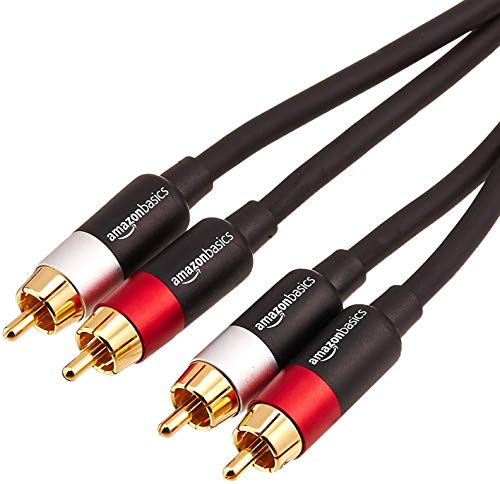
Gold-plated dual RCA cables with superior shielding reducing interference. 1.2m length ideal for turntable connections. Reliable performance.
If your turntable lacks a built-in phono stage, the Cambridge Audio Alva Duo is the right preamp at this speaker budget. MM/MC compatible, British-engineered, quiet noise floor, and the natural pairing for any mid-range turntable feeding decent bookshelf speakers.

Premium MM/MC phono preamp with exceptional transparency and low noise floor. British engineering delivering audiophile-grade performance. Ideal upgrade for Rega and Pro-Ject turntables.
As an Amazon Associate, we earn from qualifying purchases.
Products Mentioned in This Guide
Find Your Perfect Setup
Answer a few quick questions and get personalised recommendations.
Start the QuizFrequently Asked Questions
What type of speakers do I need for a turntable?
You need either powered (active) speakers with a built-in amplifier, or passive speakers connected to a separate amplifier or receiver. For simplicity, powered bookshelf speakers are ideal - they connect directly to your turntable with a simple RCA cable and require no additional equipment.
What are the best budget speakers for a turntable?
The Edifier R1280T offers exceptional value with multiple inputs and surprisingly good sound. Stepping up, the Edifier R1700BT adds Bluetooth and more power, perfect for medium-sized rooms.
Are studio monitors good for vinyl?
Studio monitors can be excellent for turntables, offering accurate, detailed sound. Popular choices include the PreSonus Eris E3.5, Mackie CR3-X, and JBL 305P MkII. However, they are designed for nearfield listening (desktop distance) rather than room-filling sound.
Should I buy passive or powered speakers?
Powered speakers are simpler and more cost-effective for most people - no separate amplifier needed. Passive speakers offer more flexibility and upgrade potential, but require a good amplifier (adding $200-$500 to your budget). Choose powered unless you already own an amplifier or plan to build a larger hi-fi system.
Related Guides
Best Turntables with Speakers 2026 | Complete Setup from $250
Buying GuideBest Budget Turntables 2026: Top Picks Under $200
Buying GuideBest Record Players 2026: Expert Picks at Every Budget
Buying GuideBest Turntables Under $500 2026: Rega vs Pro-Ject vs Audio-Technica
Buying GuideBest Speakers for Turntables UK 2026 | Active & Passive
Ready to find your perfect setup?
Our quiz matches you with the right turntable, speakers, and accessories.
Take the Quiz - It's FreeNo email required